AuditVisor provides comprehensive DPDPA Compliance Services to help organizations comply with India’s Digital Personal Data Protection Act, 2023. Our services help businesses establish effective privacy practices, manage personal data responsibly, strengthen data security, and prepare for regulatory requirements.
The Digital Personal Data Protection Act (DPDPA), 2023 governs how organizations:
• Collect and process personal data of individuals (Data Principals)
• Obtain, manage, and withdraw consent
• Protect personal data through reasonable security safeguards
• Handle data breaches and grievances
• Engage data processors and third partiesNon-compliance can lead to *significant financial penalties, reputational damage, and operational disruption*.


Any organization that collects, stores, or processes personal data of individuals in India must comply with the Digital Personal Data Protection Act.

Technology platforms handling user registrations, payments, or behavioral data must ensure compliant data collection and consent practices.

Businesses that collect customer information for orders, delivery, payments, or marketing must follow DPDPA data protection requirements.

Banks, NBFCs, and fintech companies processing sensitive financial and identity data must implement strong data protection and governance controls.

Entities managing patient records, health information, or diagnostic data must ensure secure handling and lawful processing of personal data.

Early-stage companies collecting user information through apps, websites, or platforms must implement privacy practices aligned with DPDPA.

Companies sharing personal data with vendors, analytics providers, or cloud platforms must ensure proper data protection agreements and oversight.

OPTION 1: On-Site Fieldwork
We will provide you with an itinerary of our on-site visit in advance and work closely with you to make sure the fieldwork runs smoothly. During this time, we'll conduct thorough walkthroughs, assess control effectiveness through testing procedures, gather necessary documentation for review, and more - all while keeping timeliness top of mind. Once completed, we’ll present the initial results during a final exit interview session so that there is clarity around the next steps needed to generate your SOC report. Our aim is 90-95% completion at the end of site visits; ensuring accuracy as well as timely delivery!
OPTION 2:Auditing just got easier - AuditSimple streamlines the process, leveraging technology to provide a virtual audit engagement solution that saves time and effort. Using minimal hardware requirements paired with collaborative software and cameras, we can confidently complete audits in real-time. Additionally, our secure server network provides us with access to required databases used during an audit process; this eliminates manual procedures or lengthy processing times associated with manual processes saving us a considerable amount of time during auditing engagements as well as unnecessary travel time.


A detailed evaluation of your current data protection practices against DPDPA requirements, identifying compliance gaps, risk areas, and prioritized remediation actions.
Comprehensive identification and documentation of how personal data is collected, processed, stored, and shared across systems and third parties.
Development or enhancement of privacy policies, consent notices, and mechanisms to manage user consent and withdrawal in accordance with DPDPA.
Establishment of internal policies, roles, accountability structures, and operational processes required to manage personal data responsibly.
A prioritized implementation roadmap with recommended technical, organizational, and procedural controls to achieve DPDPA readiness and support regulatory reviews.






Deep understanding of Indian regulations combined with global compliance frameworks, ensuring your business stays audit-ready across jurisdictions.

An integrated approach that blends advisory, audit, and technology to simplify compliance and accelerate certification timelines.

Designed in line with international frameworks like ISO 27701 and GDPR principles to help you meet global compliance expectations.

Flexible engagement models that grow with your business, from early-stage startups to large-scale enterprises.

A dedicated compliance expert who acts as your extended team, ensuring seamless communication and faster query resolution.
DPDPA is India’s data protection law that governs how organizations collect, process, store, and protect personal data of individuals.
Any organization that collects or processes personal data of individuals in India, including startups, SaaS companies, fintech firms, and e-commerce platforms, may be required to comply.
Organizations must obtain valid user consent, implement reasonable security safeguards, manage data responsibly, respond to user rights requests, and report data breaches when required.
Non-compliance can result in significant financial penalties and regulatory action depending on the severity of the violation.
While both laws focus on protecting personal data and user rights, DPDPA is specifically designed for India’s regulatory environment and may have different requirements for consent, data governance, and enforcement.
AuditVisor provides gap assessments, data mapping, privacy framework development, governance implementation, and compliance readiness support to help organizations align with DPDPA requirements.
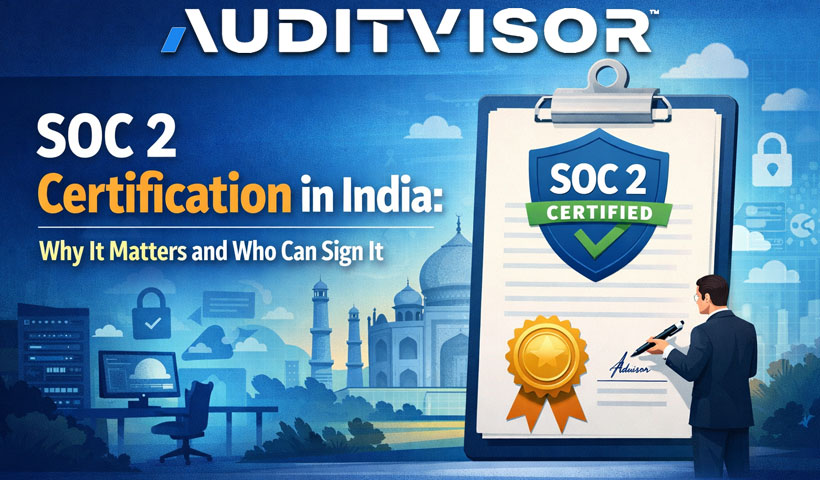
SOC 2 certification is a key trust standard for Indian companies serving global customers. This blog explains why SOC 2 matters, who needs it, the difference between Type I and Type II, and who is authorized to sign a SOC 2 Certification in India.
Read
SOC 1 audits are essential for organizations that influence their clients’ financial reporting, providing assurance on controls related to financial accuracy. However, the path to SOC 1 compliance can...
Read
In today’s digital age, cybersecurity threats are constantly evolving, affecting businesses of all sizes. SOC for Cybersecurity reports provide a framework for organizations to assess and communicate...
Read
SOC 2 compliance is essential for organizations that handle sensitive client data. While achieving SOC 2 can enhance client trust and regulatory standing, the process is challenging, especially...
Read
As businesses strive to build trust and meet regulatory demands, SOC (System and Organization Controls) audits have become essential tools for validating internal controls. However, it’s not just about ...
Read
When organizations look to provide assurance on their internal controls, they often face a critical decision: SOC 1 or SOC 2? Both types of audits fall under the SOC (System and Organization Controls) framework...
Read
In today’s digital landscape, data privacy and security are top priorities for businesses across all sectors. Many organizations handle sensitive client information, from financial records to health data..
Read
As regulatory standards around data security and compliance become stricter, SOC (System and Organization Controls) audits have emerged as an essential tool for service organizations seeking to build trust with clients and ...
Read
Ensure your organization is operating with the highest standards of trust and compliance. Contact us today to schedule your HIPAA audit.

Florida, USA
AUDITVISOR LLC
1007 N FEDERAL HWY F2
Fort Lauderdale FL, 33304 United States
info@auditvisor.com


.svg)
"Auditvisor" is the brand name for AUDITVISOR CPA AND ADVISORS LLC, Auditvisor LLC, and Audivisor Solutions LLC. The first two are independently owned and operated licensed CPA firms providing attest services in compliance with relevant regulations and professional standards, while Audivisor Solutions LLC, also independently owned and operated, offers non-attest cybersecurity and compliance consulting and is not a licensed CPA firm. These entities operate under an alternative practice structure to ensure service independence and integrity, with no cross-liability, and references like "our firm" or "we" denote this collaborative structure.
.svg)

